
English
When we think of modern machinery, we often envision advanced electronics and control systems. However, the backbone of every device – from giant excavators to precision CNC machine tools – remains a solid mechanical structure. It is here, on the front line of the struggle against overloads and vibrations, that iron castings play a pivotal role. Why is this material still indispensable in the 21st century? Let’s examine the role of cast iron in the sector that drives the global economy.
What is the machinery industry?
The machinery industry is one of the most vital pillars of any developed economy. It provides the tools and equipment necessary for all other sectors to function – from agriculture and construction to energy, mining, and transport.
The sector involves the design, production, and maintenance of machines and technical equipment. This encompasses not only final products like tractors or lathes but also the manufacturing of complex sub-assemblies: engines, gearboxes, drive systems, and power hydraulics. It is a sector that demands immense precision, innovation, and materials with the highest durability parameters.
The Polish machinery industry in the European context
For years, Poland has been building its position as a key player on the industrial map of Europe. We are no longer just an assembly plant but increasingly a center for advanced manufacturing and engineering. According to market data, Poland holds a leading position in the European Union regarding the export of machinery parts and accessories.
Our competitive advantage lies in the combination of long-standing foundry and metallurgical traditions with a modern machine park. European contractors – especially from Germany, France, and Italy – value Polish suppliers for their high quality of workmanship, punctuality, and flexibility. In this context, Polish foundries such as ELZAMECH have become strategic partners for international giants, delivering components that meet rigorous EU standards.
Iron castings in the machinery industry
Why do engineers so frequently turn to iron castings? In an era of composites and light alloys, cast iron still wins in key categories. Its role in the machinery industry stems from a unique combination of physical and economic properties. Below are the most important features that make cast iron the material of choice for machine designers.
- Vibration damping capacity. This is the most crucial feature in machine construction. Grey cast iron (the most popular in this industry) excellently absorbs vibrations generated during engine operation or machining. As a result, machines operate more quietly, stably, and precisely.
- Excellent machinability. Iron castings are easy to process (turning, milling, drilling), allowing for complex shapes while maintaining high dimensional accuracy.
- High wear resistance. Many machine components operate under friction (e.g., guideways). Thanks to its graphite content, cast iron has natural lubricating properties, which extends the lifespan of sub-assemblies.
- Production economics. Casting technology allows for the mass production of elements with complex geometries much more cheaply and quickly than machining from a solid steel block or welding structures.
Industry fact
Did you know that the bodies of most CNC machine tools in the world are made of cast iron? No other material at a reasonable price provides such stiffness and thermal stability, which is crucial when precision measured in micrometers is required.
Examples of iron castings for the machinery industry
The versatility of iron castings means they can be found in almost every mechanical device. Depending on the requirements, different grades of this alloy are used – from classic grey iron to extremely durable ductile (nodular) iron.
Typical examples of iron castings found on the market include:
- machine bodies and beds – foundations for lathes, milling machines, presses, and drills. They form the skeleton that must support the weight of the entire structure and eliminate vibrations;
- gearbox and reducer housings – these must be leak-proof, durable, and resistant to stress. Iron castings are ideal as enclosures for gear systems operating in oil baths;
- pulleys and flywheels – due to their high mass and structural homogeneity, these elements ensure smooth rotational movement and kinetic energy accumulation;
- hydraulic components – pump bodies, valves, and manifolds. Here, the tightness of the casting and its resistance to high pressure are key;
- agricultural machinery parts – wheel hubs, bearing housings, or plow components – these must be exceptionally resistant to harsh field conditions and impacts.
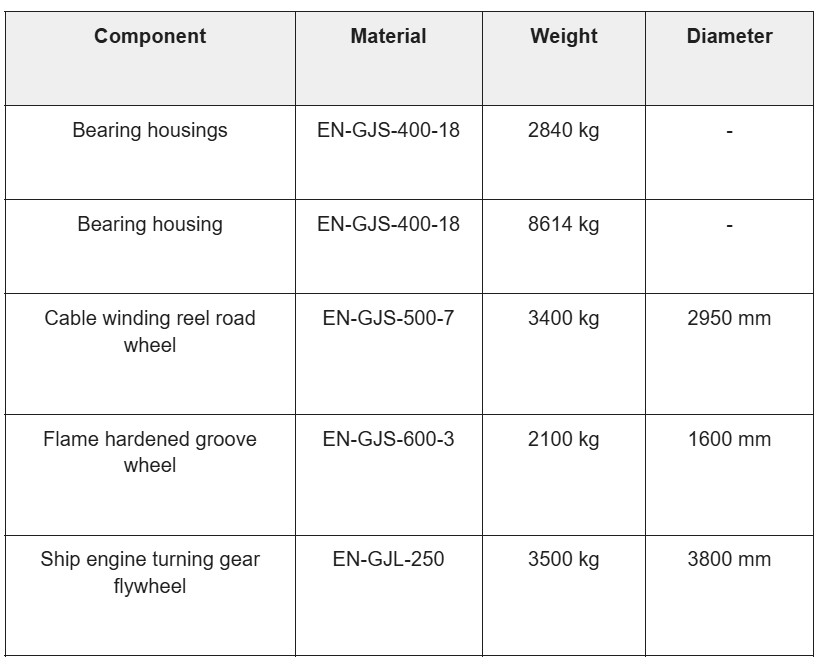
Sample ELZAMECH iron castings for the machinery industry
The machinery industry cannot exist without proven material technologies. Although the world is moving forward, iron castings remain a guarantor of durability and reliability. For ELZAMECH, creating these components is not just a metallurgical process, but the art of combining tradition with modern engineering. When choosing a casting supplier, it is worth partnering with those who understand the specifics of the machinery industry and can deliver a product that will withstand years of the heaviest work.
