
English
The dynamic development of the renewable energy sector, particularly offshore and onshore wind power, compels manufacturers of cast components to push the boundaries of material durability. Among the most vital elements of any modern wind turbine are large-scale wind turbine castings, which form the structural foundation for power generation systems. The transition from welded structures to advanced iron castings has become the market standard, driven by the need for weight reduction, increased rigidity, and the assurance of failure-free operation for a minimum of 25 years in aggressive environments.
Ductile iron in wind turbine castings
Contemporary wind engineering relies on specific grades of ductile iron. The selection of this material is deliberate; wind turbine castings must exhibit a unique combination of high ductility and low-temperature fracture toughness.
For companies operating offshore farms, the critical parameter is the material's impact strength at temperatures reaching -20°C or even -40°C. Under these conditions, LT (Low Temperature) ductile iron maintains its ferritic structure, preventing brittle fracture caused by sudden wind gusts or wave impacts. Professional metallurgical processing during the casting stage ensures perfectly spherical graphite nodules, which minimizes internal stress concentration and determines the exceptional fatigue resistance of the components.
Cast iron components for the wind power industry
The design and production of elements such as hubs or bearing housings are processes characterized by the highest level of technological complexity. Each of these elements performs a specific function within the turbine's kinematic chain. The ELZAMECH iron foundry produces the following components for the wind energy industry.
Hub
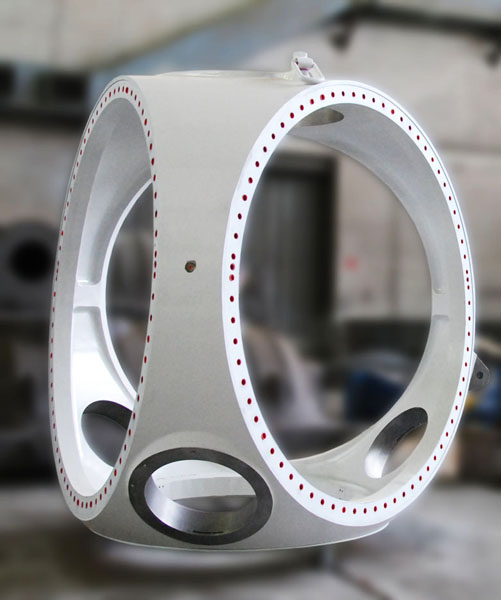
The hub is arguably the most dynamically loaded element of the entire turbine. It connects the blades to the main shaft, transferring massive bending and torsional moments. Wind turbine castings in the form of hubs must be characterized by absolute structural homogeneity. Any internal defects, such as shrinkage or micro-porosity, could lead to catastrophic failure under centrifugal forces – especially considering that hubs cast by ELZAMECH range in weight from 9,340 kg to as much as 21,500 kg. Modern casting methods allow for the optimization of hub wall thickness, reducing mass while increasing strength at critical blade-mounting locations.
Bearing housing
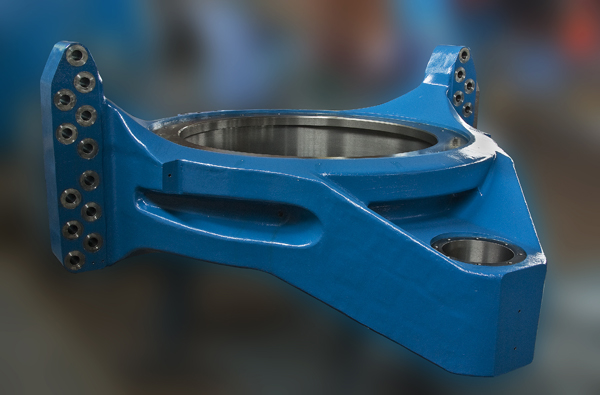
The bearing housing is a component upon which the stability of the main shaft and gearbox efficiency depend. It requires extreme rigidity to prevent micro-deformations under wind load, which could disrupt the system's alignment. These castings require high-precision machining post-casting. The inherent rigidity of ductile iron allows for the maintenance of rigorous dimensional tolerances, directly resulting in reduced friction, lower bearing operating temperatures, and fewer service interventions.
Pitch stiffening element
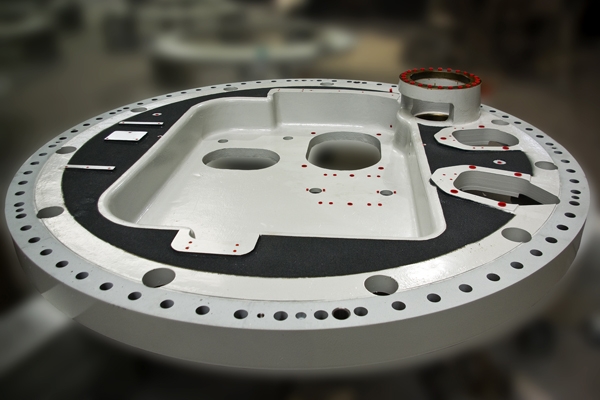
In the renewable energy sector, stiffeners are structural components whose primary function is to increase the geometric stiffness and resistance of the structure to deformation without excessively increasing the total mass of the entire system. These elements, often called stiffeners, are designed to modify the moment of inertia of the supporting element's cross-section. In practice, this means they prevent localized loss of stability under compressive, bending, or torsional loads.
The photo below shows the stiffening ring at the base of the nacelle. Thanks to its massive, annular geometry, this element ensures the maintenance of a perfectly circular cross-section at the nacelle-to-tower junction. This is critical for the rotation bearing to operate without jamming under the enormous bending forces. This casting transfers stresses from the entire main frame to the turbine tower. It acts as a "stiffening link," dissipating concentrated forces over a larger surface area.
Quality control of wind turbine castings
Business entities in the energy sector are well aware that the cost of replacing a single component in an offshore turbine can exceed the cost of the device itself. Therefore, wind turbine castings are subject to the most stringent control procedures in the heavy industry.
Every component leaving the facility must be accompanied by full NDT documentation. Ultrasonic testing is the standard for verifying structural integrity in thick-walled hub sections. Magnetic particle testing, in turn, allows for the exclusion of surface cracks that could initiate fatigue corrosion in saline marine environments. Only such a restrictive approach to quality enables the achievement of a Levelized Cost of Energy (LCOE) that guarantees the profitability of investments in renewable wind energy.
Why partner with the ELZAMECH iron foundry?
The wind engineering of the future involves turbines with increasingly larger rotor diameters. This presents the foundry industry with new challenges regarding the dimensions and mass of castings. Choosing a partner that understands ductile iron metallurgy and can deliver wind turbine castings with the highest parameters is a crucial decision for every manufacturer in the energy sector. Investing in casting quality is an investment in decades of safe and efficient green energy production.
