
English
The dynamic development of renewable energy (RES) places demands on metallurgy that go beyond standard industrial norms. Components operating in wind turbine nacelles - such as hubs, main frames, or bearing housings are subjected to extreme bending forces and variable load cycles over approximately 25 years of operation. In this context, wind turbine castings represent a pinnacle of materials engineering, requiring uncompromising manufacturing quality.
The challenge of low-temperature operation
In the wind energy sector, durability is measured in decades, imposing a design rigor unseen in other industrial branches. Selecting a material that precisely combines high yield strength with guaranteed impact strength in extreme low temperatures is not just a technical issue - it is the foundation of safety and the economic predictability of RES investments. In environments where components are subject to constant fatigue cycles and aggressive corrosivity, there is simply no margin for metallurgical error.
The greatest challenge for wind turbine castings is the phenomenon of embrittlement at low temperatures. Standard ductile irons can lose their plastic properties in Arctic or offshore conditions. Therefore, high-quality wind turbine castings are produced from ferritic grades with controlled impact strength. Key roles are played by grades such as EN-GJS-400-18, which feature an elongation level of at least 18%. This allows the structure to operate safely even during sudden wind gusts, where the material must absorb the impact energy without the risk of structural failure. The choice of ductile iron is not accidental - it offers an ideal balance between weight, strength, and the ability to form complex shapes.
Quality control of wind turbine castings
Manufacturing castings for wind turbines requires a meticulous process approach. To meet the requirements and extreme loads, an iron foundry must apply a rigorous verification protocol at every stage of the casting's creation.
Strict control of metallurgical purity and the charge
The foundation of quality is the precise selection of raw materials. The process begins with the use of exclusively certified charges with restrictively limited content of harmful elements, such as phosphorus and sulfur. Their excess leads to the formation of brittle precipitates at grain boundaries, which drastically reduces the material's impact strength. In metallurgy dedicated to RES, maximum purity is pursued, which minimizes the risk of fatigue cracks under long-term operation.
Advanced non-destructive testing (NDT)
The structural integrity of each component is confirmed through a series of NDT tests. The use of ultrasonic testing (UT) allows for the detection of internal material defects, such as shrinkage or non-metallic inclusions, which could become crack initiation centers. Additionally, magnetic-particle testing (MT) and penetrant testing (PT) serve to exclude the smallest surface discontinuities, guaranteeing that every casting leaving the plant is free from hidden defects.
Impact testing at extreme temperatures
Castings operating in offshore wind turbines and in harsh land climates must maintain plasticity even in severe frost. Therefore, material samples are subjected to impact testing at controlled cryogenic temperatures (e.g., -20ºC and -40ºC). Confirming the material's ability to absorb impact energy at such low temperatures is crucial for avoiding the phenomenon of brittle fracture, which could lead to a catastrophic failure of the entire support structure.
Dynamic thermal and metallographic analysis
A modern foundry does not wait for the finished product to check its structure. Monitoring the graphite spheroidization process takes place in real-time by means of thermal analysis (TA). This allows for precise control of crystallization even at the liquid metal stage. Consequently, we ensure that the graphite will take the desired nodular form and the ferritic structure will be homogeneous throughout the cross-section, which is particularly difficult and important in the case of large-scale castings with thick walls.
Precise 3D dimensional verification
With dimensions reaching several meters and weight counted in tons, maintaining dimensional tolerance is a huge engineering challenge. The use of measuring arms and 3D scanners allows for the creation of a digital twin of the casting and its comparison with a CAD model. Such precision is of critical importance for optimizing machining allowances and ensures an ideal fit of the casting with precision main bearings and turbine drive systems.
Thanks to such a reliable approach, the final product becomes a monolith ready for the most difficult engineering challenges, which directly translates into energy stability, safety, and continuity of investments in the RES sector.
Specific requirements for castings in the RES sector
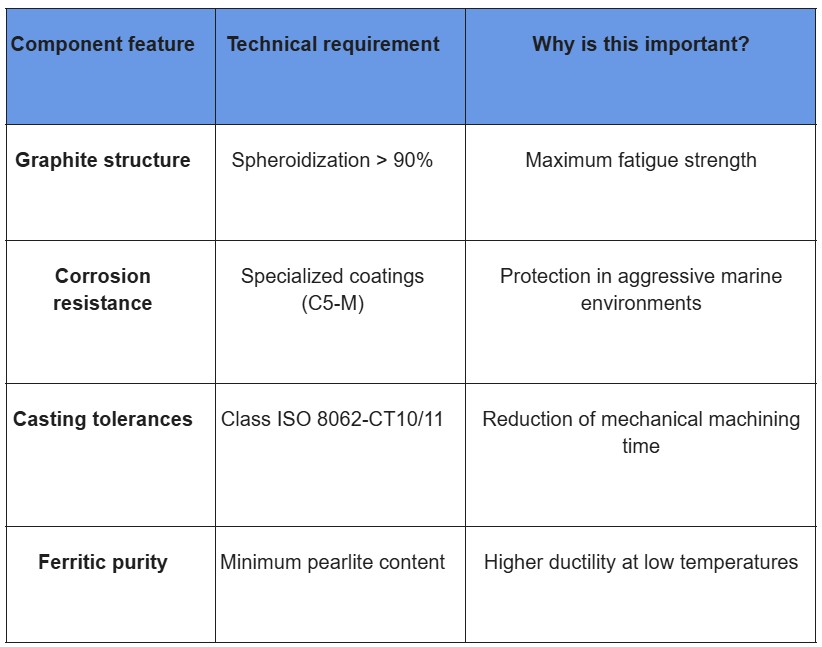
A key factor influencing the structural safety of modern wind units is the synergy between the casting geometry and its ferritic microstructure. Optimization of cross-sections and the deliberate elimination of potential stress concentrations allow for a significant reduction in the weight of critical components, radically improving the statics of the entire support system. In the energy sector, where efficiency is inextricably linked with material reliability, choosing components with certified strength parameters becomes a mandatory requirement. Ensuring durability throughout the full 25-year operational cycle is the only rational path to minimizing fatigue risk and maximizing the technical availability of wind farms.
